PRODUCTS SEARCH
Picture|Purity Industrial Centrifugal Pump
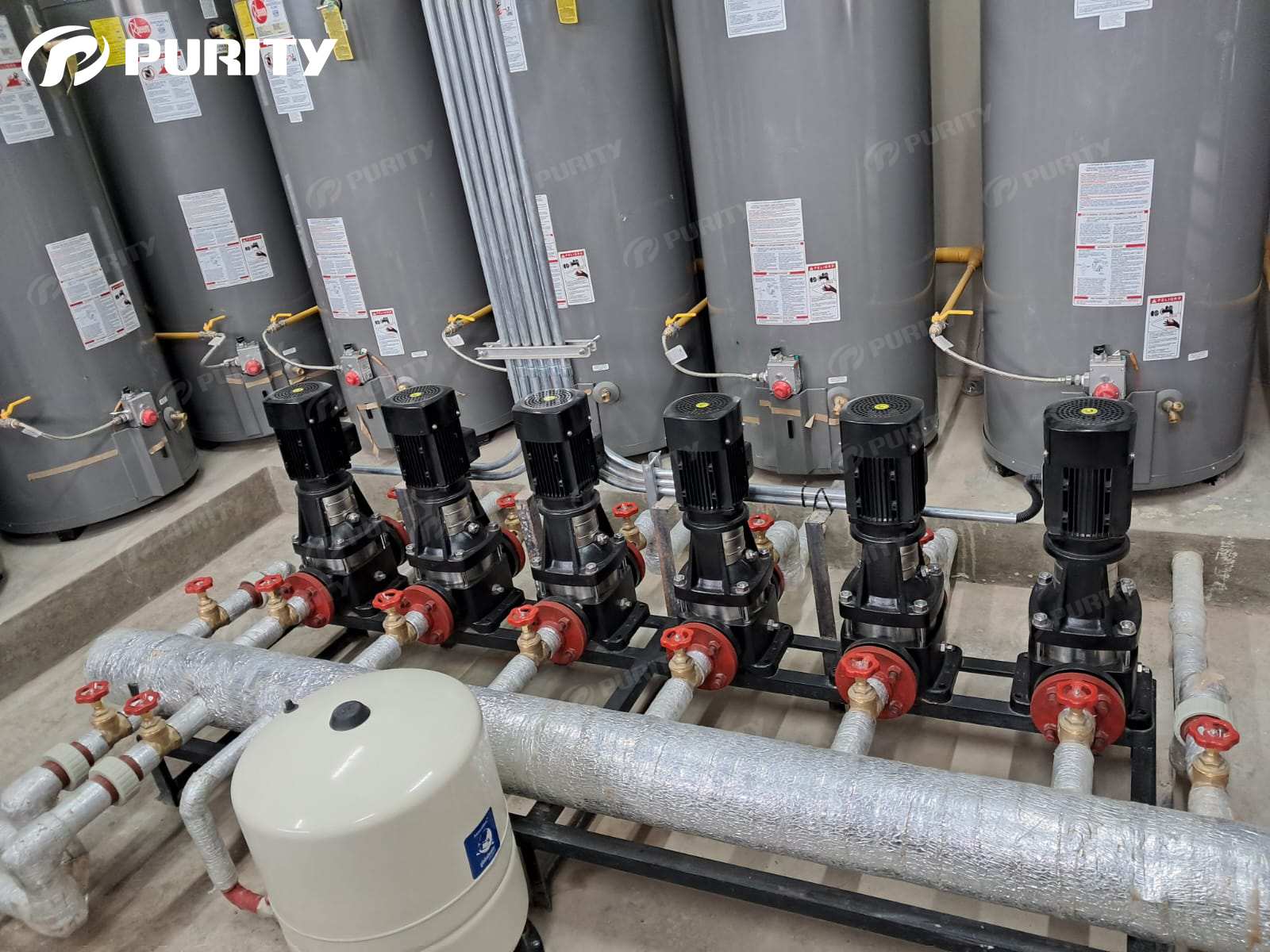
An industrial centrifugal pump is widely used in water supply, wastewater treatment, HVAC systems, agricultural irrigation, manufacturing, and industrial fluid transfer. However, choosing the right pump involves more than comparing motor power or rated flow. Flow rate, total head, fluid properties, installation conditions, and operating efficiency all affect pump performance.
This industrial centrifugal pump guide explains how centrifugal pumps work, explores common centrifugal pump types, and provides practical tips for selecting and maintaining the right pump for your application.
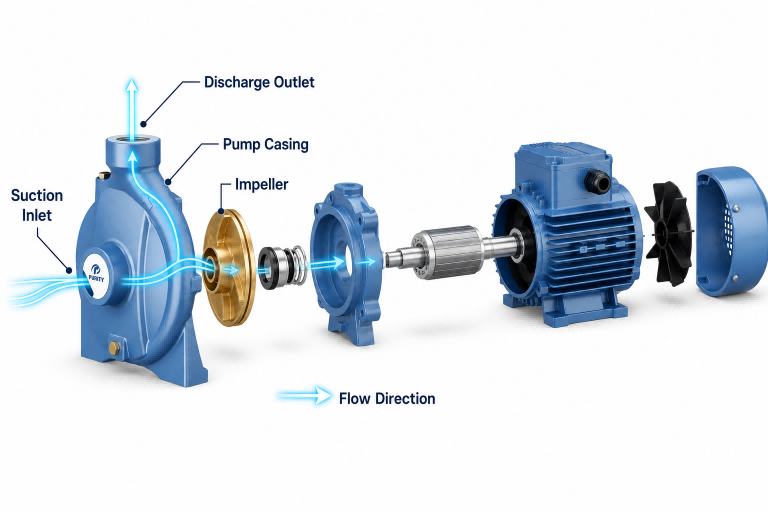
Its working process follows four basic steps:
1. Liquid enters the pump through the suction inlet.
2. The rotating impeller accelerates the liquid outward.
3. The pump casing converts part of the liquid's velocity into pressure.
4. Pressurized liquid leaves through the discharge outlet.
Typical components include the impeller, pump casing, shaft, bearings, mechanical seal or packing, and motor. Their design and materials influence flow capacity, head, efficiency, durability, and compatibility with different fluids.
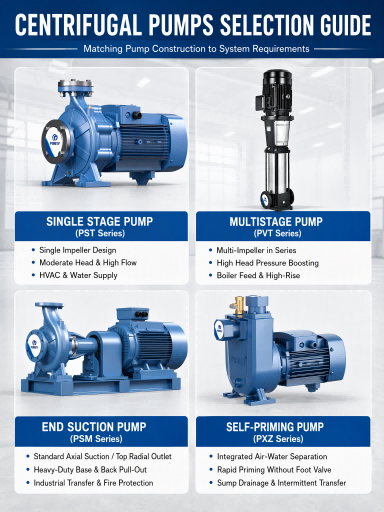
(1)Single Stage Centrifugal Pump
A single stage centrifugal pump uses one impeller to generate flow and pressure. Its relatively simple structure makes it suitable for general water supply, irrigation, cooling water circulation, and building services.
Single-stage designs are often preferred when moderate head requirements and straightforward maintenance are priorities. However, applications requiring substantially higher pressure may need a different configuration.
(2)Multistage Centrifugal Pump
A multistage centrifugal pump uses multiple impellers arranged in series. Each stage adds pressure, making this design suitable for high-head applications such as boiler feed, high-rise building water supply, industrial boosting, and water treatment.
(3)End Suction Centrifugal Pump
An end suction centrifugal pump typically has an axial suction inlet and a discharge outlet positioned radially. Its established design, broad application range, and convenient installation make it a common choice for industrial water transfer, HVAC, irrigation, and general-purpose pumping.
(4)Self-Priming Centrifugal Pump
A self-priming centrifugal pump can remove air from its suction line under suitable operating conditions, helping establish liquid flow without manual priming after the initial setup. It can be useful where suction conditions or intermittent operation make conventional arrangements less convenient.
(5)Axial Flow, Mixed Flow, and Radial Flow Pumps
These pumps differ in how the impeller directs liquid and generates head.
① Axial flow pumps: Designed primarily for high flow and low head.
② Mixed flow pumps: Balance relatively high flow with moderate head.
③ Radial flow pumps: Direct liquid outward and are widely used for applications requiring moderate to high head.
The best design depends on actual system requirements rather than motor power alone.
Industrial centrifugal pumps serve a wide range of applications:
(1) Industrial water supply: Process water, equipment cooling, and circulation systems.
(2) Wastewater treatment: Suitable pump designs handle wastewater and, where specified, suspended solids.
(3) HVAC systems: Circulation of chilled water and hot water in commercial and industrial facilities.
(4) Agricultural irrigation: Water transfer and distribution across irrigation networks.
(5) Building services: Water supply, pressure boosting, and drainage.
(6) Chemical and industrial processes: Fluid transfer requiring careful consideration of corrosion resistance, temperature, viscosity, and material compatibility.
For abrasive, corrosive, viscous, or solids-containing liquids, pump materials, seals, impeller design, and hydraulic performance must be evaluated before selection.
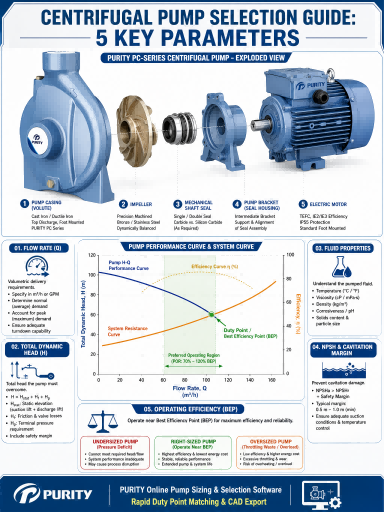
(1) Flow Rate
Flow rate (Q) describes the volume of liquid delivered per unit of time. Common units include m³/h, L/min, L/s, and GPM. Determine both normal and peak demand before selecting a pump.
(2) Total Head
Total head (H), measured in meters, represents the energy supplied to the liquid per unit weight. It is not simply the vertical lifting height. Static elevation, pipe friction, fittings, valves, and required discharge pressure must also be considered.
(3) Fluid Properties
Confirm the liquid's temperature, density, viscosity, corrosiveness, abrasiveness, and solids content. These properties influence pump construction, materials, seals, and motor requirements.
(4) Net Positive Suction Head (NPSH)
Insufficient suction conditions can cause cavitation, which may lead to noise, vibration, reduced performance, and impeller damage. The available NPSH of the system should exceed the pump's required NPSH, with an appropriate margin based on operating conditions and engineering guidance.
(5) Operating Efficiency
Check the pump performance curve and system curve to identify the actual operating point. Ideally, the pump should operate near its best efficiency point (BEP), where hydraulic performance is generally most favorable.
An oversized pump may waste energy through throttling or operate inefficiently, while an undersized pump may fail to meet the required flow or pressure.
Efficient operation depends on both pump design and the overall system.
(1)Optimize piping: Appropriate pipe sizing and fewer unnecessary restrictions help reduce friction losses.
(2)Use variable frequency drives (VFDs): Speed control can reduce energy consumption in systems with changing flow demand.
(3)Monitor operating conditions: Track flow, pressure, vibration, bearing temperature, and energy consumption to identify performance changes.
(4)Follow preventive maintenance: Inspect seals, bearings, lubrication, shaft alignment, pipe connections, and impellers at suitable intervals.
If flow, head, or power consumption changes unexpectedly, investigate the pump and system rather than allowing inefficient operation to continue.

Purity Pump, founded in 2010, specializes in industrial pumps and complete water supply solutions. With 16+ years of manufacturing experience, Purity offers a range of pumping solutions, including single-stage, multistage, horizontal, vertical, sewage, and fire pump systems.
For product selection, buyers should provide the required flow rate, total head, fluid properties, operating conditions, and installation requirements. This information helps the technical team recommend a more appropriate solution.
Explore Purity Pump's pump selection tool or visit cnpurity.com to learn more about available solutions.
(1)What is the difference between a single-stage and a multistage centrifugal pump?
A single-stage centrifugal pump has one impeller, while a multistage pump uses multiple impellers in series to generate higher pressure. The appropriate choice depends on the required flow and head.
(2)How do I choose the right centrifugal pump?
Start by determining the required flow rate and total head. Then evaluate fluid properties, NPSH, installation conditions, operating efficiency, and maintenance requirements.
(3)What industries use industrial centrifugal pumps?
They are commonly used in manufacturing, water treatment, HVAC, agriculture, building services, and industrial fluid transfer.
(4)What should I look for in a centrifugal pump manufacturer?
Consider product quality, technical expertise, performance data, manufacturing capabilities, relevant certifications, customization, and after-sales service.
Choosing the right industrial centrifugal pump requires a complete understanding of the application, hydraulic requirements, fluid properties, and system conditions. By comparing centrifugal pump types and evaluating flow, head, NPSH, and efficiency, buyers can reduce energy waste and improve operational reliability.
Purity Pump focuses on product quality and customer needs, providing pumping solutions for diverse industrial applications. Looking for a suitable pump solution or a potential distribution partnership? Contact Purity Pump to discuss your requirements.