PRODUCTS SEARCH
Losing prime does not necessarily mean the pump is damaged. Understanding the common causes and following a systematic troubleshooting process can help identify the problem, reduce downtime, and prevent unnecessary repairs.
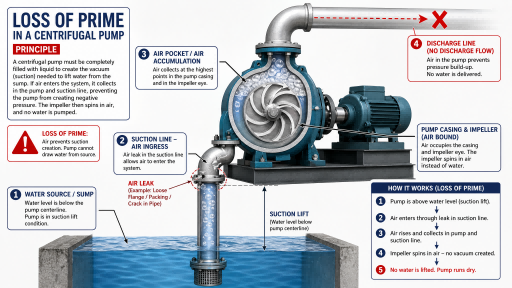
For a centrifugal water pump installed above its water source, maintaining a liquid-filled suction line is particularly important. Pumps supplied with positive inlet pressure may not require the same priming procedure. A self-priming centrifugal pump can remove air from its suction line under suitable conditions, but most models still require an initial liquid charge according to the manufacturer's instructions.
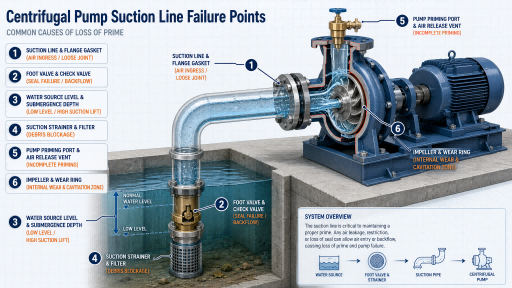
Loose connections, damaged gaskets, cracked pipes, or worn seals can allow air to enter the suction system. Because the suction side may operate under negative pressure, air can enter without producing visible water leakage.
What to check: Inspect pipe joints, flange connections, threaded fittings, filter covers, and seals. Use an appropriate leak or vacuum test when necessary.
A foot valve or check valve helps retain water in the suction line after shutdown. If it cannot seal properly, water may drain back into the source, allowing air to enter the system.
Typical sign: The pump works after being refilled but loses prime after several hours or overnight.
What to check: Inspect the valve for debris, wear, damage, and poor sealing.
A falling water level increases the actual suction lift. If the inlet becomes insufficiently submerged, the pump may draw in air. Excessive suction lift and high friction losses can also prevent the pump from operating reliably.
What to check: Measure the water level, verify inlet submergence, and review suction pipe diameter, length, fittings, and the pump's allowable operating conditions.
Sand, debris, and deposits can restrict water entering the pump. Excessive suction resistance may reduce flow and contribute to cavitation, which can cause noise, vibration, and unstable operation.
What to check: Inspect the strainer, inlet, valves, and suction pipe for blockages or deformation.
A self-priming centrifugal pump is designed to remove air under specified conditions, but it is not necessarily designed for dry running. Insufficient initial filling, excessive suction lift, blocked air-release passages, or trapped air can prevent successful priming.
What to check: Confirm the priming procedure, valve positions, pipe layout, and permitted suction lift in the manufacturer's manual.
If the external suction system appears normal, worn impellers, wear rings, or other internal components may reduce pump performance. Changes in liquid temperature, fluid properties, or entrained gas can also affect suction conditions.
What to check: Compare current flow, pressure, and temperature readings with previous records. Arrange an internal inspection if necessary.
|
Symptom |
First areas to check |
|
Pump loses prime after shutdown |
Foot valve, check valve, and water draining back |
|
Pump suddenly stops delivering water |
Air leaks, low water level, or air entering the inlet |
|
Pump cannot prime after installation |
Initial filling, trapped air, and excessive suction lift |
|
Flow decreases with noise or vibration |
Blockages, excessive suction losses, or cavitation |
|
Performance gradually deteriorates |
Operating conditions and internal wear |
Use these symptoms as initial clues, not definitive diagnoses. Check suction and discharge pressure, actual flow, and operating records when possible.
Before inspection, stop and isolate the equipment according to site safety procedures. Never repeatedly start a pump that requires priming while its casing is empty. Dry running can cause overheating and mechanical seal damage.
Regular maintenance can help a centrifugal pump maintain reliable suction. Inspect suction pipes and seals for air leaks, check foot valves and check valves, clean filters, monitor water levels, and follow the specified priming procedure. Record unusual noise, vibration, pressure changes, and declining flow so that developing problems can be identified early.
If the problem keeps returning, investigate the underlying cause instead of simply adding water each time.
Possible causes include loss of prime, suction-side air leaks, low water levels, blocked inlets, and internal wear. Check the suction system and operating readings before replacing components.
Most models require an initial liquid charge. Follow the manufacturer's instructions, and never assume self-priming means the pump can run dry indefinitely.
Loss of prime involves an inability to maintain the required liquid-filled condition. Cavitation occurs when local liquid pressure falls below vapor pressure, forming vapor bubbles. Both can affect performance, but they require different checks.
Reliable operation depends on correct installation, suitable pump selection, and consistent product quality. Founded in 2010, Purity Pump has more than 16 years of experience in pump manufacturing and serves customers in over 140 countries. Its product portfolio includes centrifugal pumps, self-priming models, sewage pumps, and water supply units.
As a centrifugal pump manufacturer, Purity focuses on practical pumping solutions for different applications. Its PZWM self-priming pump features a 304 stainless steel welded shaft connection, an energy-efficient motor, and threaded inlet and outlet connections for convenient installation.
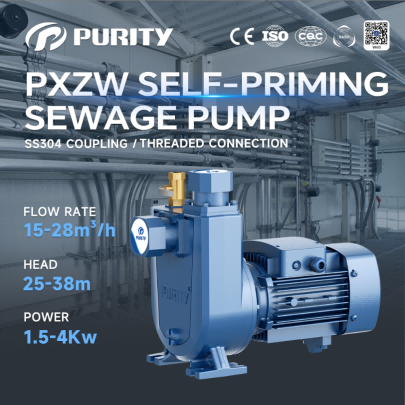
When evaluating a centrifugal pump manufacturer, compare the operating range, materials, efficiency, installation requirements, and technical support—not just the purchase price. Contact Purity Pump to discuss your pumping requirements or explore global distributor opportunities.