PRODUCTS SEARCH
When designing a fire protection system, one of the most common questions is: How many types of pumps are there in firefighting?
The answer depends on how you classify them. From a technical perspective, fire pumps can be grouped by working principle. From a commercial application perspective, they are usually categorized by structure and installation type. Understanding both perspectives is essential for engineers, contractors, and building owners who want to ensure reliable fire safety performance.
In practical engineering applications, especially under standards like NFPA 20, centrifugal fire pumps are commonly installed in four structural forms:
The horizontal split case fire pump is the most widely used solution in commercial and industrial facilities. This type of split case fire pump features a casing that splits horizontally, allowing maintenance access without removing suction and discharge piping.
Best suited for:
Facilities with adequate mechanical room space
High-flow requirements (750+ GPM)
Warehouses, manufacturing plants, shopping centers
Its durability, cost-effectiveness, and ease of maintenance make it a preferred choice in standard building systems.
A vertical version of the split case design, this pump reduces floor space requirements while retaining serviceability advantages.
Ideal for:
Space-constrained mechanical rooms
Flood-prone areas where the motor needs elevation
Mid- to high-rise commercial buildings
It balances performance, maintainability, and footprint efficiency.
Often referred to as the best vertical pipeline centrifugal fire pump for compact installations, this configuration installs directly within the piping system.
Advantages:
Minimal floor space
Simplified piping layout
Quiet operation
Limitations:
Electric-driven only
Lower flow capacity (typically under 1000 GPM)
Full disassembly required for maintenance
This type is frequently used in office buildings, hotels, and retrofit projects where mechanical space is limited.
The vertical turbine fire pump is designed for underground or static water sources, such as wells, reservoirs, or storage tanks.
Best for:
Negative suction conditions
Industrial facilities with underground water supply
High-rise or critical infrastructure requiring diesel backup
It is often the only practical solution when water must be lifted from below ground level.
A fire pump is not simply an industrial water pump used for emergencies. It is a life-safety device regulated by strict standards.
(1)A compliant fire pump must:
Meet NFPA 20 performance requirements
Achieve rated flow and pressure levels
Maintain at least 65% pressure at 150% rated flow
Operate reliably under extreme conditions
Often obtain UL and/or FM certification
(2)Include automatic start functionality
This level of regulation ensures the pump performs exactly as required during a fire event. Unlike general-purpose pumps, fire pumps are engineered specifically for emergency reliability.
There Is No “Best” Pump — Only the Right One
(3)Selecting the correct fire pump depends on:
Building height
Required system flow (GPM)
Water source type (municipal, tank, underground)
Mechanical room space
Need for diesel backup
Flood risk
Local fire code requirements
For example:
Ample space → Horizontal split case fire pump
Limited space → Vertical split case or vertical in-line pump
Underground water source → Vertical turbine fire pump
Proper hydraulic calculation and professional design are essential to ensure system compliance and operational safety.
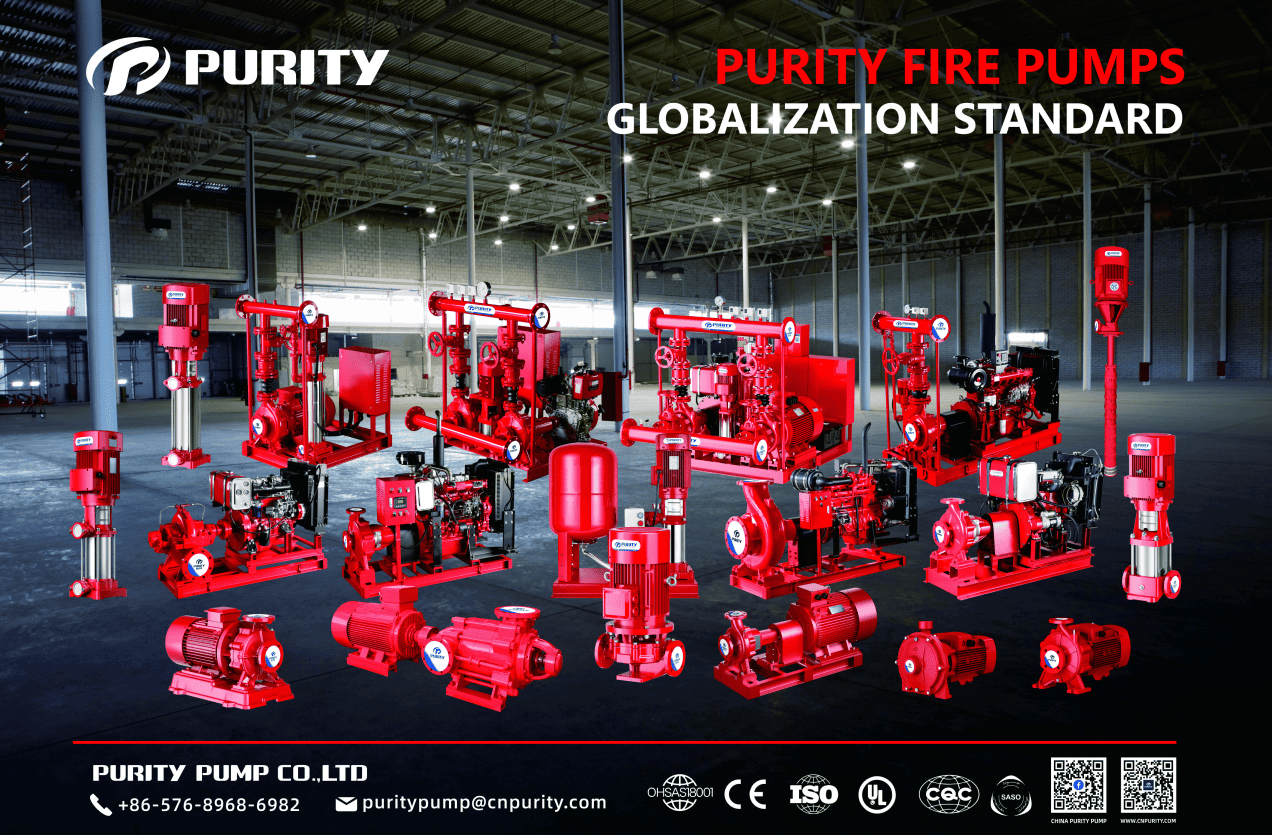
As a professional fire pump company, Purity offers a complete range of firefighting pump solutions, including:
(1)Horizontal split case fire pump
(2)Vertical pipeline centrifugal fire pump
(3)Vertical turbine fire pump
(4)Complete fire pump units and systems
With a 60,000-square-meter independent manufacturing facility and over 320 employees, Purity integrates R&D, production, and quality control under one roof. Our diversified product models and parameter options allow us to meet various building and industrial fire protection needs.
Selected models have obtained UL certification, and our fire pump systems are engineered to meet international performance standards.
Purity is currently expanding its global distribution network and actively seeking international partners.

So, how many types of pumps are there in firefighting?
From a principle perspective, three main categories. From a commercial structural perspective, four dominant types—primarily centrifugal designs.
The key is not the number of types, but selecting the right fire pump for your specific application. With proper design, compliance, and a reliable manufacturing partner, your fire protection system will deliver the performance needed when it matters most.
If you are looking for a trusted fire pump company with complete product lines and strong manufacturing capability, Purity is ready to support your project.