PRODUCTS SEARCH
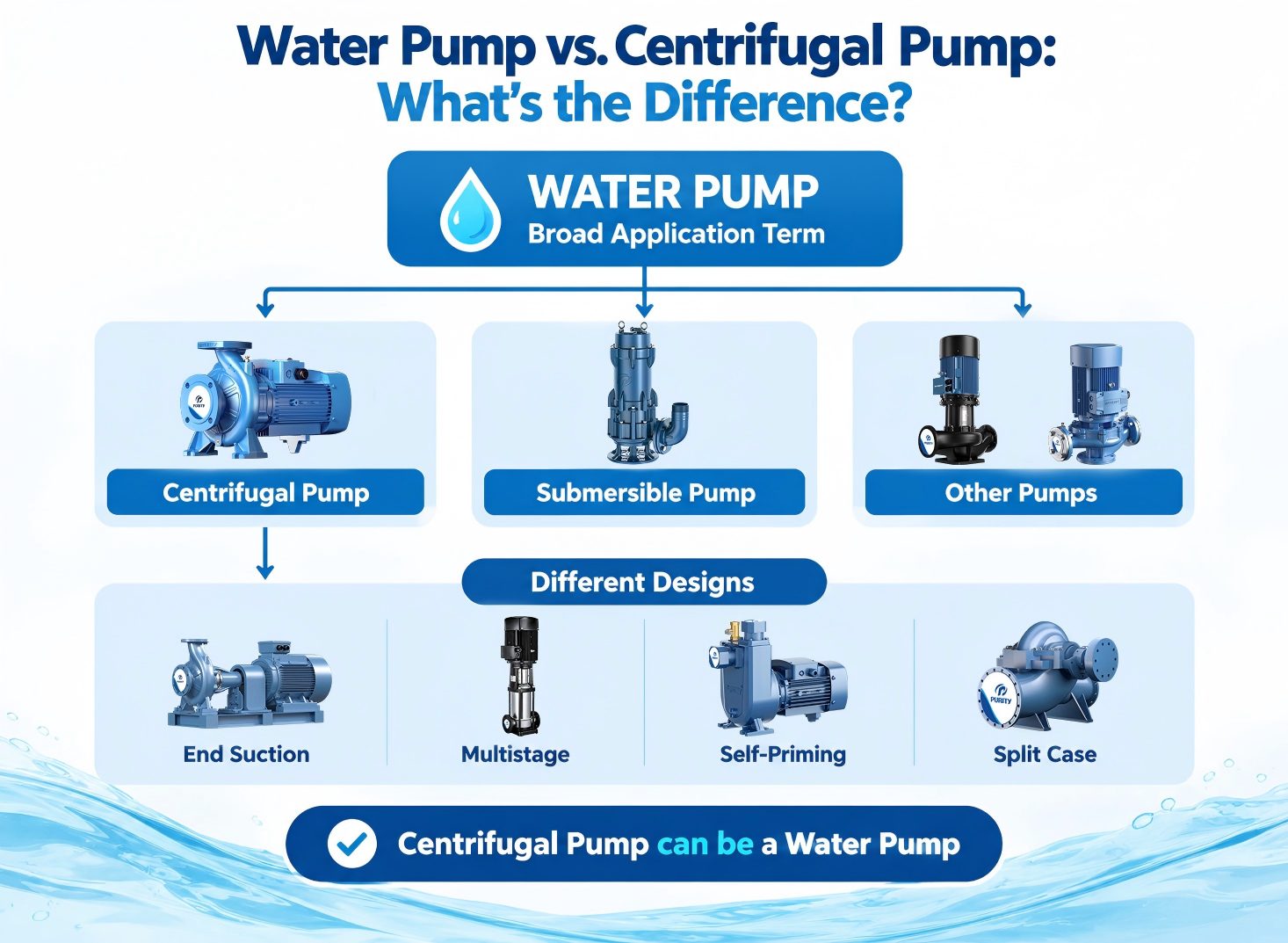
Picture|Water Pump vs. Centrifugal Pump
When choosing a pump for a water supply, irrigation, industrial, or drainage system, you may come across the terms water pump and centrifugal pump. Although these terms are sometimes used interchangeably, they do not describe the same thing.
The simplest way to understand the difference is this: “water pump” describes what a pump is used for, while “centrifugal pump” describes how a pump works. A centrifugal pump can be a water pump, but not every water pump is a centrifugal pump.
A water pump is a general term for a pump designed to move water from one location to another. It may be used to increase pressure, transfer water, drain wastewater, supply buildings, or support irrigation and industrial systems.
Because “water pump” describes the application rather than a specific operating principle, many different pump types can be considered water pumps. These include centrifugal pumps, submersible pumps, self-priming pumps, multistage pumps, and other designs.
In other words:
Water Pump = A broad application category
Centrifugal Pump = A specific pump type based on operating principle
This distinction is important when selecting a pump because the name “water pump” alone does not tell you enough about its structure, performance, or suitability for a particular application.
Picture|Centrifugal Pump Working Principle
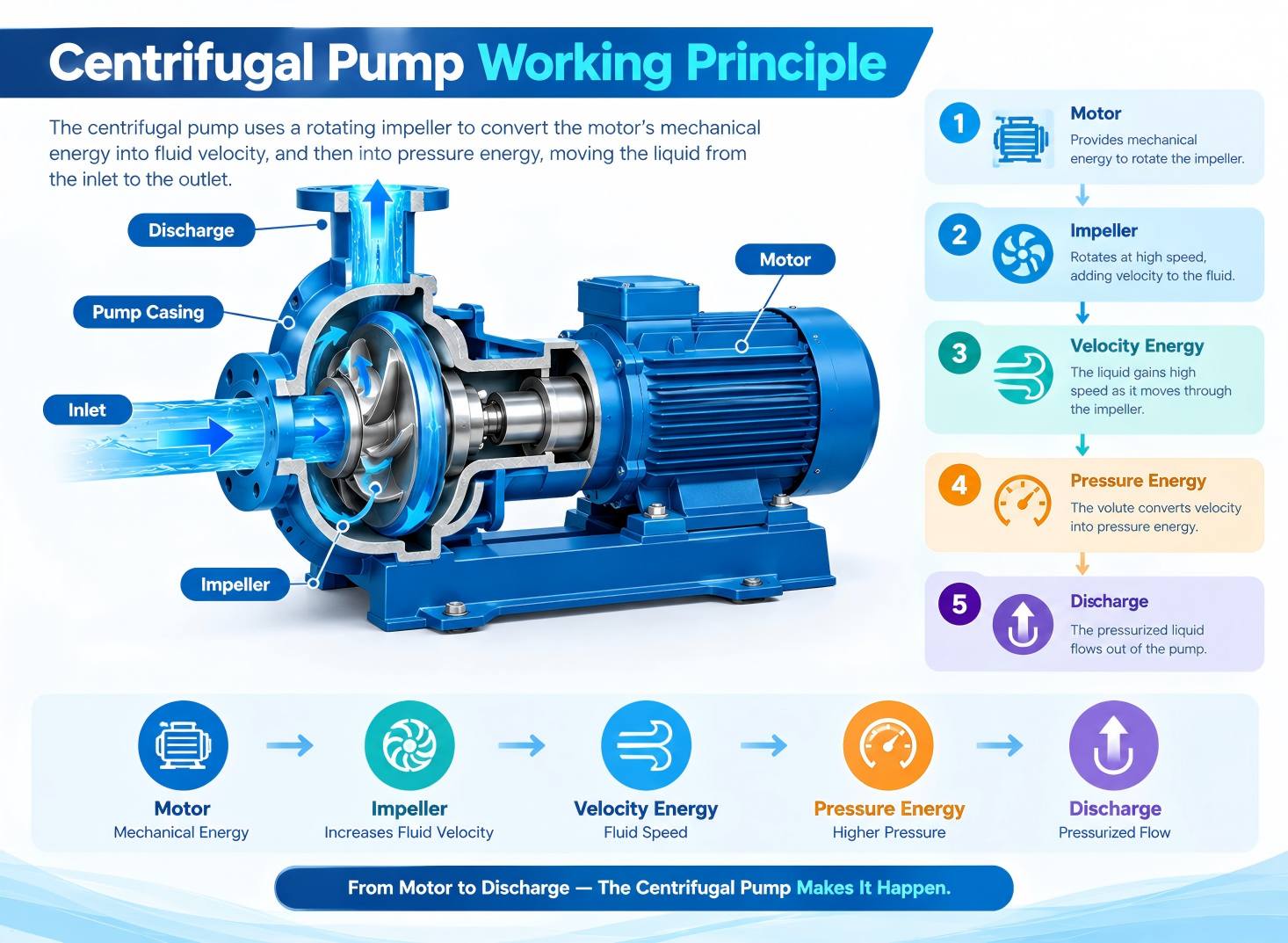
A centrifugal pump is a dynamic pump that uses a rotating impeller to transfer mechanical energy to a fluid. It is one of the most widely used pump types for transporting water and other low-viscosity liquids.
So, what is centrifugal pump technology based on? Its operation mainly depends on converting mechanical energy into fluid velocity and then into pressure.
The basic centrifugal pump working principle can be summarized as:
Motor or engine → Impeller rotation → Fluid velocity increases → Pump casing converts velocity into pressure → Fluid is discharged
When the impeller rotates, water enters the pump and is accelerated outward by the impeller. The pump casing then helps convert part of this velocity energy into pressure energy, allowing the water to flow through the discharge system.
This continuous energy-transfer process makes centrifugal pumps particularly suitable for applications requiring relatively high flow rates and continuous operation.
A centrifugal pump is not a single product. There are many types of centrifugal pump, and they can be classified according to structure, flow direction, installation method, and application.
Common examples include:
· End-suction centrifugal pumps
· Horizontal centrifugal pumps
· Vertical centrifugal pumps
· Multistage centrifugal pumps
· Split-case centrifugal pumps
· Self-priming centrifugal pumps
· Submersible centrifugal pumps
· Inline and pipeline centrifugal pumps
Different designs are suitable for different operating conditions. For example, multistage pumps are commonly used when higher pressure or head is required, while end-suction pumps are widely used for general water transfer and industrial applications.
The broad operating range of centrifugal pumps makes centrifugal pumps in industry particularly common. They are widely used in water supply, irrigation, HVAC systems, fire protection, wastewater treatment, municipal projects, and industrial processes.
However, centrifugal pumps are not always the best choice. They generally perform well with large flow rates, relatively low-viscosity liquids, and continuous fluid transfer. Positive displacement pumps may be more suitable for high-viscosity liquids, very high pressures, low flow rates, or precise metering applications.
Therefore, pump selection should always be based on actual operating conditions rather than simply choosing a centrifugal pump because it is commonly used.
The key to centrifugal pump selection is matching the pump to the operating conditions. Important factors include:
You should also consider NPSH and cavitation risk, priming requirements, dry-running conditions, liquid temperature, viscosity, and whether the pump will operate continuously or under variable conditions.
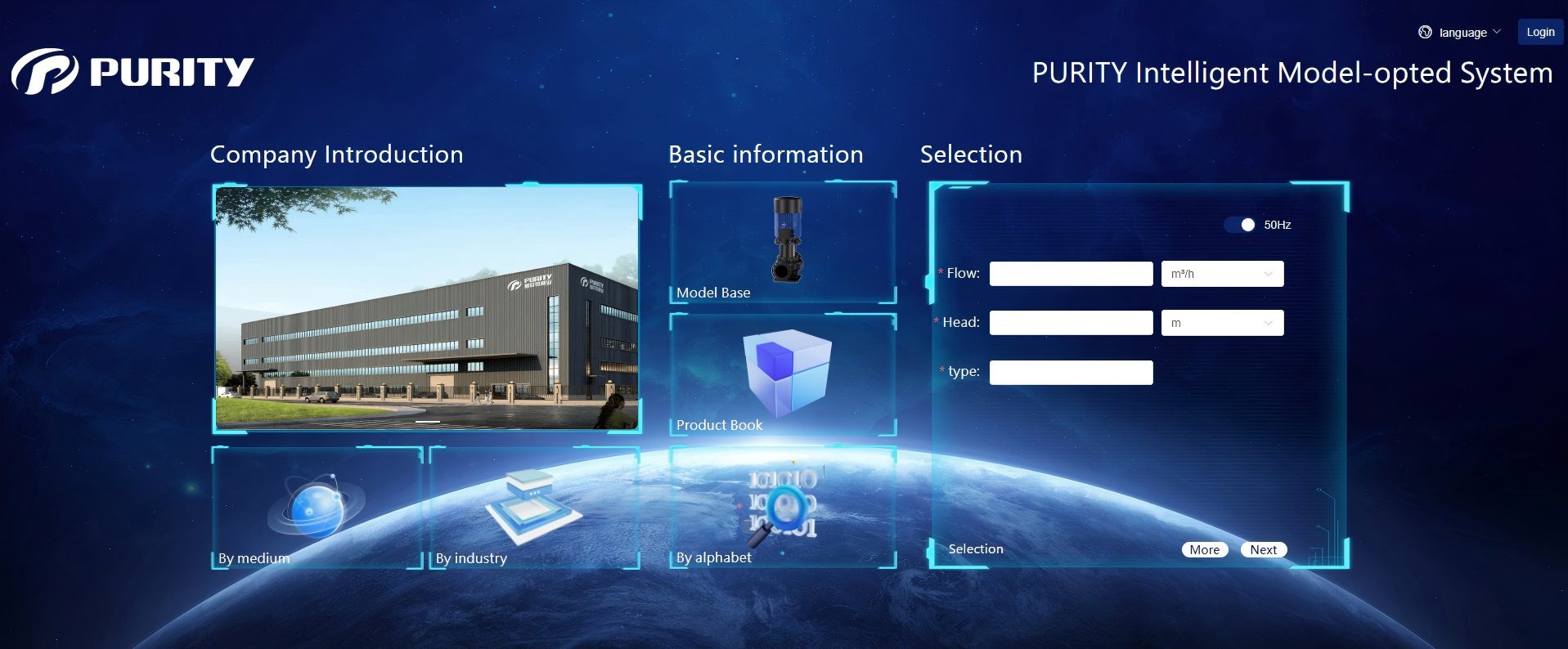
Purity Model Selection Website:https://purity.xpump.net/web/#/EN/Index
· Flow: How much liquid needs to be transferred?
· Head: How much pressure or lifting height is required?
· Fluid: What liquid will be pumped?
· Solids: Does the fluid contain suspended particles?
· Installation: Is the pump horizontal, vertical, submersible, or inline?
· Material: Is corrosion resistance required?
· Efficiency: Can the pump operate close to its best efficiency point (BEP)?
With 16+ years of production and sales experience, Purity provides a wide range of industrial pump solutions, including horizontal centrifugal pumps, vertical multistage pumps, self-priming pumps, sewage pumps, fire pump systems, and water supply units.
Purity operates its own 60,000 m² factory and has an annual production capacity of more than 150,000 pumps. Its products are exported or supplied to customers in 140+ countries, with certifications and qualifications including CE, ISO, and SASO.
Having its own manufacturing facilities allows Purity to maintain greater control over production, quality inspection, and product consistency compared with companies that mainly rely on third-party manufacturing.
For pump selection, Purity also provides an online selection tool that helps users match pump models with their required operating conditions.
Ultimately, the difference between a water pump and a centrifugal pump is not simply about two different products. Water pump is a broad application term, while centrifugal pump refers to a specific operating principle and pump family. Understanding this distinction is the first step toward selecting the right pump for your system.
Purity is also looking for distributors and agents worldwide. If you are interested in industrial pump cooperation, OEM/ODM solutions, or becoming a Purity partner, feel free to contact us.