PRODUCTS SEARCH
Sizing a fire pump is not about simply picking a model from a catalog—it is a code-driven hydraulic matching process. Engineers must evaluate whether a pump is needed, calculate system demand, and then select a pump that delivers the required performance under real fire conditions. Whether you are working with a diesel fire pump, an electric fire pump, or a complete fire pump system, the logic remains the same.
The first step is often overlooked: determine if a fire pump is required at all.
A fire water pump is only needed when the available water supply cannot meet the system demand.
(1)If water supply ≥ required flow and pressure → No pump needed
(2) If water supply < system demand → Fire pump required
Engineers typically rely on hydrant flow tests to collect:
(1) Static pressure
(2) Residual pressure
(3) Flow rate
These values are then compared with system demand. The goal is simple:
match supply vs demand before adding equipment.
In many cases, system optimization—such as increasing pipe size—can reduce or eliminate the need for a pump, saving cost and complexity.
Fire pump sizing is governed by standards such as NFPA 13 and NFPA 14. The system demand consists of two main components:
Flow Rate (GPM)
Flow is determined by the most demanding scenario, not average conditions.
Typical calculation includes:
(1) Sprinkler density × design area
(2) Additional safety margin (e.g., 30%)
(3) Hose stream demand
In high-rise buildings, standpipe systems often govern the total flow requirement.
Key principle:
Always design for the worst-case fire scenario.
Pressure (PSI)
Pressure is calculated by summing all system losses and requirements:
P_{total}=P_{static}+P_{residual}+P_{friction}+P_{devices}+P_{safety}
This includes:
(1) Elevation loss (static head)
(2) Required pressure at the most remote point
(3) Pipe friction losses
(4) Losses through valves and backflow preventers
(5) Safety margin
Key principle:
Pressure reflects the total resistance the system must overcome.
Once demand and supply are known, the role of the fire pump becomes clear:
A fire pump does not supply everything—it only makes up the difference.
Pump Boost = System Demand − Available Supply
For example:
(1) Required pressure: 78 psi
(2) Available supply: 40 psi
(3) Pump boost needed: 38 psi
This applies to all pump types:
(1) Electric fire pump (most common for reliability and efficiency)
(2) Diesel fire pump (used when power is unreliable or unavailable)
Both must meet the same hydraulic requirements.
Selecting a fire pump is not about picking a number—it’s about matching a performance curve.
Flow Selection
The operating point should fall within:
(1) 100%–150% of rated flow
(2) Ideally between 115%–135%
Avoid selecting too close to 150%, where performance becomes less stable.
Curve Matching (Critical Step)
According to NFPA 20:
At the required flow:
Pump pressure ≥ system required pressure
The design point must lie below the pump curve
This ensures the pump can reliably meet system demand.
Performance Limits
NFPA also requires:
At 150% flow:
Pump head ≥ 65% of rated head
This prevents steep curves where pressure drops too quickly as flow increases.
Key principle:
Choose a pump that comfortably covers your demand point—not just meets it.
A key takeaway from engineering practice:
Optimize the system before increasing pump size
This includes:
(1) Increasing pipe diameter
(2) Reducing friction losses
(3) Improving piping layout
(4) Zoning high-rise buildings
Especially in tall buildings, pressure limits (typically 400 psi) require zoning rather than simply installing a larger pump.
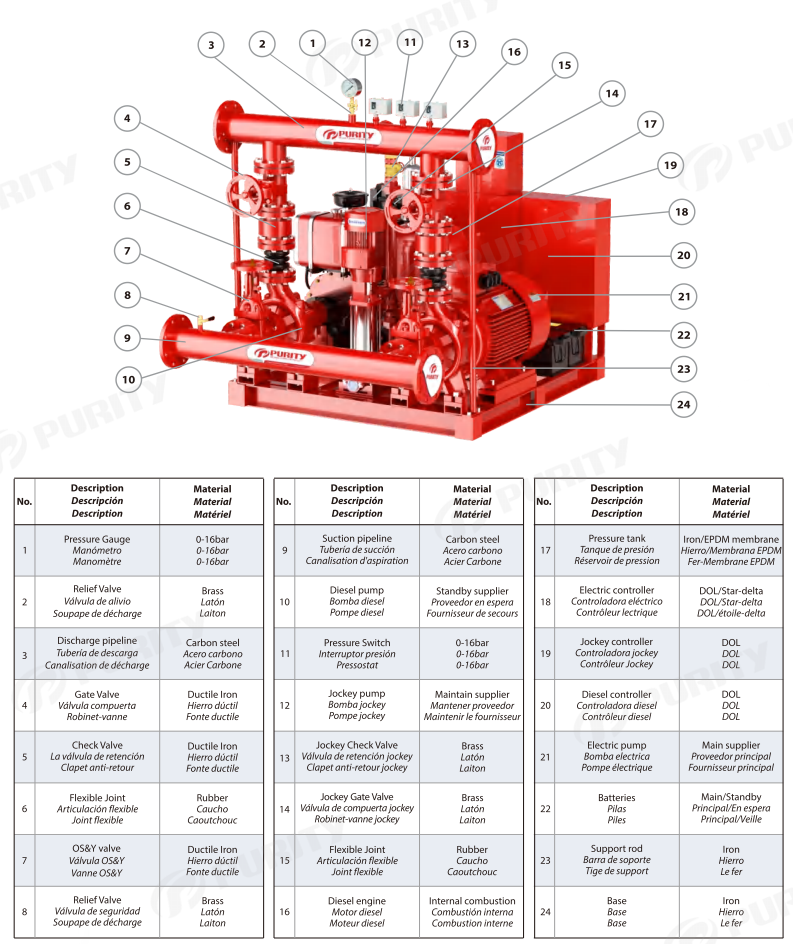
A complete fire pump system includes:
(1) Pump (electric or diesel)
(2) Controller
(3) Jockey pump (pressure maintenance)
(4) Valves and accessories
The right system must meet both hydraulic performance and code compliance.
When selecting a fire water pump, reliability and certification are critical. Purity offers strong advantages:
1. Full range of fire pump models to meet diverse project needs
2. Certified products including CE, SASO, ISO, and selected UL approvals
3. 16+ years of manufacturing experience with a 60,000 m² production base
4. Dedicated R&D team ensuring high efficiency and durability
Try the Purity selection tool:
https://purity.xpump.net/web/#/EN/Index
We are actively seeking global partners—contact us to become your trusted fire pump supplier.
Sizing a fire pump is a structured engineering process:
1. Determine if a pump is needed
2. Calculate flow and pressure demand
3. Identify the required pressure boost
4. Select a pump based on curve matching
A well-sized fire pump ensures reliable fire protection, minimizes cost, and guarantees system performance when it matters most.