PRODUCTS SEARCH
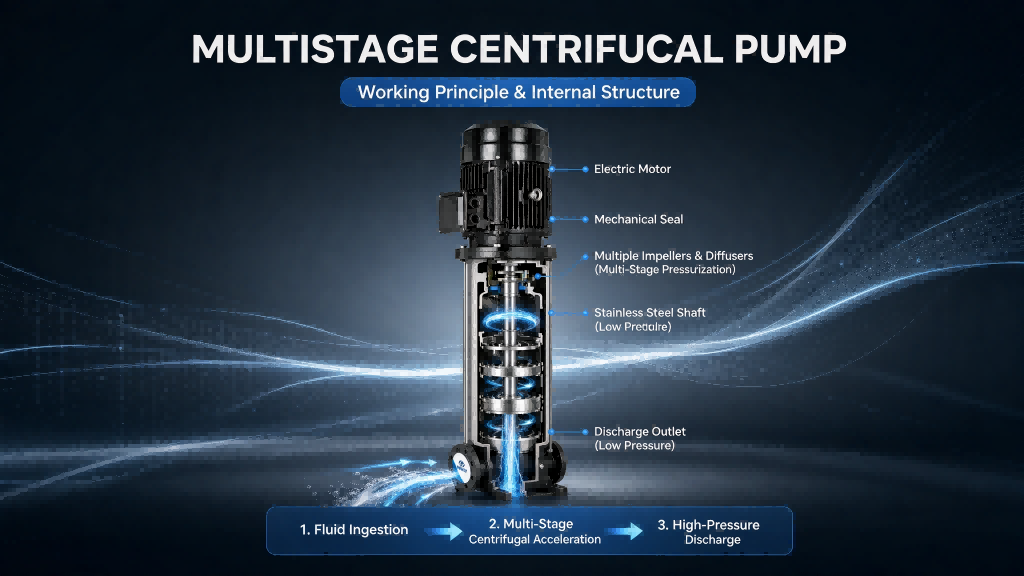
A multistage centrifugal pump is designed to deliver high pressure and head using multiple impellers arranged in series. It is widely used in high-rise buildings, industrial water supply, boiler feed, and water treatment. Understanding its working principle, types, and applications helps users select the right pump for their systems.
A multistage centrifugal pump is a pump equipped with two or more impellers connected in series. Each impeller transfers energy to the liquid, gradually increasing its pressure as it passes through successive stages.
Unlike a single-stage centrifugal pump, which uses only one impeller, a multistage pump generates higher total head by combining the energy produced at each stage. Its flow rate generally remains similar throughout the stages, while the total head increases with the number of impellers.
This makes multistage centrifugal pumps ideal for applications requiring high pressure and reliable water delivery.
A multistage centrifugal pump increases liquid pressure through three main steps:
Liquid Inlet: Water enters the first impeller through the suction inlet.
Energy Transfer: The rotating impeller accelerates the liquid. Guide vanes or diffusers direct it to the next stage, where additional energy is transferred.
Pressure Output: The liquid passes through successive impellers, gaining head at each stage before leaving through the discharge outlet.
The total pump head is approximately the sum of the head generated by each stage under the same operating conditions.
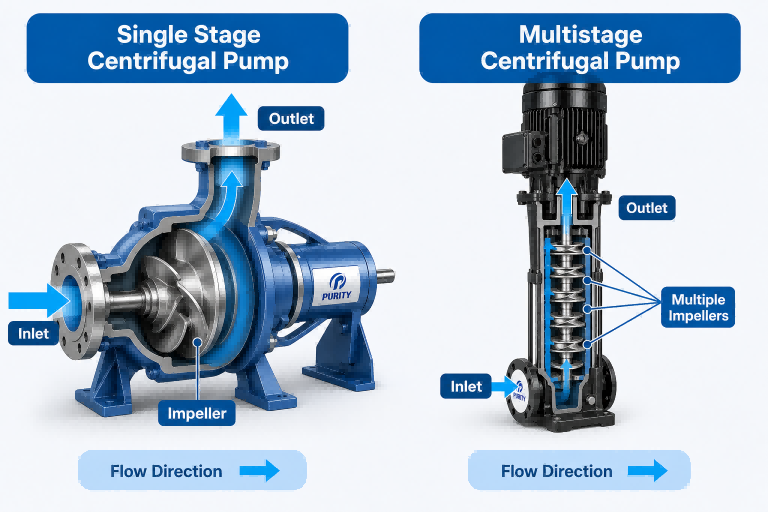
The main difference lies in the number of impellers and the total head each pump can generate.
|
Comparison |
Single-Stage Pump |
Multistage Pump |
|
Impellers |
One |
Two or more |
|
Head |
Generally lower |
Generally higher |
|
Flow Rate |
Depends on design |
Depends on design |
|
Structure |
Simpler |
More complex |
|
Applications |
Water transfer and circulation |
Pressure boosting and high-pressure supply |
Single-stage pumps are suitable for general water transfer, while multistage pumps are often preferred when higher discharge pressure or head is required.
1. Vertical Multistage Pump
A vertical multistage pump features a vertically arranged shaft with multiple impellers stacked along the same axis. Its compact design saves installation space and suits:
High-rise building water supply
Boiler feed systems
Reverse osmosis (RO) water treatment
Industrial circulation
High-pressure cleaning
2. Horizontal Multistage Pump
A horizontal multistage pump uses a horizontally arranged shaft with multiple impellers connected in series. It is commonly used in industrial water supply, boiler feed, and applications where horizontal installation and maintenance access are preferred.
3. Stainless Steel Vertical Multistage Pump
A stainless steel vertical multistage pump combines a space-saving structure with corrosion-resistant wetted components. It is suitable for drinking water supply, food processing, and water treatment applications where material compatibility and water quality matter.
The appropriate stainless steel grade should be selected according to the liquid's chemical properties and operating conditions.
Key Advantages of Multistage Centrifugal Pumps
(1)Multistage centrifugal pumps offer several benefits for high-head applications:
(2)High Head: Multiple impellers work in series to generate higher total head.
(3)Compact Design: Vertical configurations reduce floor space requirements.
(4)Flexible Performance: Different stage numbers can meet various head requirements.
(5)Reliable Operation: Proper selection helps maintain stable flow and pressure.
Wide Applications: Suitable for commercial buildings, industrial systems, and water treatment facilities.
Typical Applications
Multistage centrifugal pumps are widely used in systems requiring high head and reliable water delivery.
Commercial Buildings: Boosting water pressure in high-rise buildings.
Industrial Systems: Supplying water to boilers and industrial equipment.
Water Treatment: Providing pressurized water for RO systems.
Agriculture: Supporting irrigation where higher delivery head is required.
High-Pressure Cleaning: Delivering pressurized water for industrial cleaning equipment.
Selecting the right pump requires evaluating five key factors:
(1)Flow Rate: Determine the required water volume per hour.
(2)Total Head: Calculate elevation differences and pipeline friction losses.
(3)Liquid Properties: Check temperature, viscosity, and chemical characteristics.
(4)Pump Materials: Choose suitable materials, such as stainless steel, based on the liquid and operating environment.
(5)Installation: Select vertical or horizontal configurations according to available space and maintenance requirements.
For better energy efficiency and reliable operation, the pump should ideally operate near its best efficiency point (BEP).
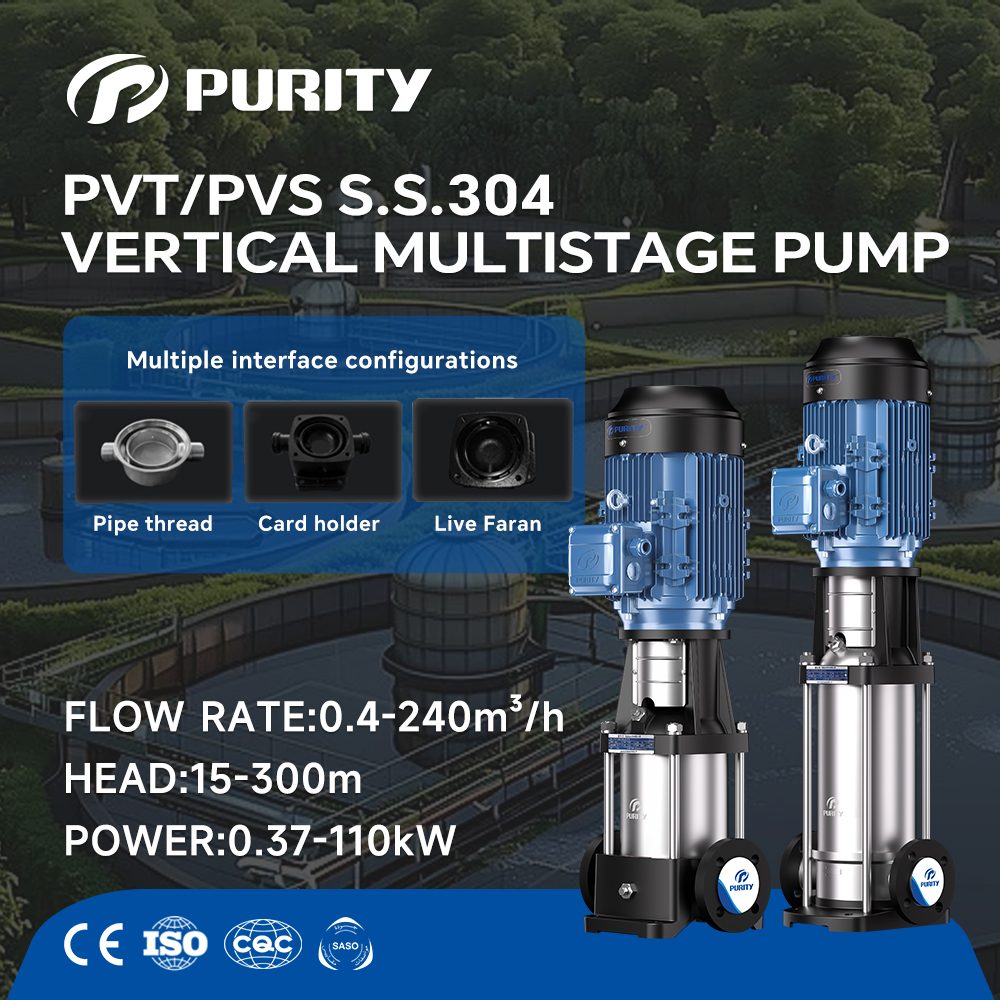
With 16+ years of pump manufacturing experience, Purity offers professional pump solutions and selection support for customers worldwide.
1. What is the main purpose of a multistage centrifugal pump?
It delivers liquid at high pressure or head, making it suitable for building water boosting, boiler feed, and industrial water supply.
2. Does a multistage pump increase pressure or flow?
It primarily increases head through multiple impellers arranged in series. Flow rate mainly depends on pump design and operating conditions.
3. How many impellers does a multistage centrifugal pump have?
It has two or more impellers connected in series. The number of stages depends on the required head and pump design.
4. Is a vertical multistage pump better than a horizontal pump?
Neither is universally better. Vertical pumps save floor space, while horizontal pumps may offer easier maintenance access in certain installations. The choice depends on the application and installation conditions.
Multistage centrifugal pumps provide an effective solution for high-head water supply and pressure boosting. Understanding their working principles, configurations, and selection factors helps users choose the right pump. Explore Purity PVT vertical multistage pumps or contact our team for professional selection support.